


Less Compliance in Your OT Practice: Shifting Toward More Interoception
If you’ve ever sat across from a client who shut down or refused to engage mid-session and wondered, “What am I missing?”, you are not alone.
For a long time, the prevailing answer was more pressure. More reinforcers. More behavior charts. More structure designed to get compliance out of a person who was already overwhelmed.
But here is what I’ve come to believe after more than 24 years as an occupational therapist: when participation becomes difficult, more compliance is rarely the answer.
Less compliance in an OT practice is not a radical idea. It is an interoception-informed shift in how we understand behavior, support regulation, and help our clients do hard things, not because we pressured them into it, but because we helped them understand what their body needed to make it possible.
What Does Less Compliance in Occupational Therapy Actually Mean?
Less compliance in occupational therapy is not about removing expectations, lowering the bar, or letting clients do whatever they want. I want to be really clear about that, because it is one of the most common misconceptions I hear.
Less compliance is an interoception-informed OT therapy approach that shifts the central question from:
“How do I get this person to do it?” to: “What might this person’s body need right now to make doing it more possible?”
In a compliance-based occupational therapy framework, the primary focus is often outward performance: completing a task on demand, sitting still, following a directive, earning a reward. The assumption is that if the right system is in place, behavior will follow.
An interoception-informed, less compliance approach looks underneath the behavior first. It asks:
- Is this person in pain, hungry, or sensory overwhelmed?
- Do they need movement before they can settle into seated work?
- Is the environment too loud, too bright, or too unpredictable for their nervous system to feel safe?
- Have they been taught to ignore body signals for so long that they genuinely do not know what they need?
When we understand what is driving behavior, we can offer supports that actually work. Not because we forced compliance, but because we helped the person connect to their internal experience and identify what their body needs to participate.
This is what I mean when I talk about less compliance in OT practice. The expectations may remain the same. What changes is how we help our clients get there.
How Compliance-Based Approaches Can Work Against Us
I want to be honest with you here, even when it is a little uncomfortable to say.
I have used compliance. I still catch it sneaking into my practice. It is ingrained in so many of us because we were trained in systems that prioritized compliance. We were taught to reward the “good behavior” and reduce the “bad behavior.” We were taught that if we just had the right reinforcement schedule, things would click.
But what the research, and what so many neurodivergent adults in our community, are telling us is this: compliance-based approaches often teach people to override their body signals in order to succeed. Push through the discomfort. Mask the overwhelm. Perform appropriate behavior regardless of what is happening internally.
Over time, that pattern can make it harder to:
- Notice body signals clearly
- Trust internal experiences
- Identify what the body needs before hitting a wall
- Regulate without complete shutdown or meltdown
This is one of the most important reasons I began shifting my OT therapy approach toward interoception-informed practice. Not to abandon structure or expectations, but to build something more sustainable underneath them.
Download the Free Less Compliance Community Booklet
Over 300 parents, educators, therapists, and neurodivergent adults shared their perspectives on what less compliance really means to them. What came through, again and again, was a call for more curiosity, more collaboration, and more support for understanding what people need to navigate challenges successfully. We gathered all of those voices, examples, and insights into one free resource.
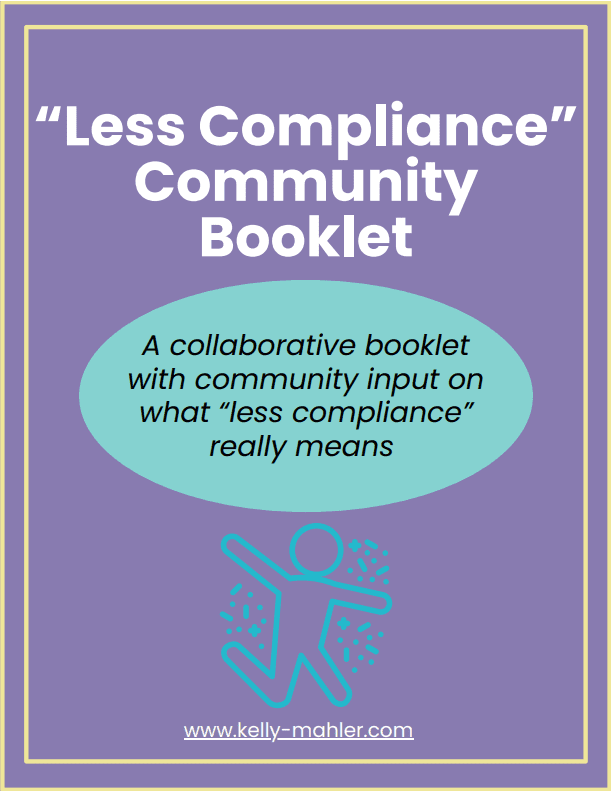
Our free 90-page Less Compliance Community Booklet features these perspectives and many more. The booklet also includes:
- Practical examples from educators, therapists, caregivers, and neurodivergent adults navigating everyday challenges through a less compliance approach
- Real-world strategies for shifting your practice, classroom, or home environment
- Language and guidance for responding to the pushback many people experience when shifting away from compliance culture and compliance-based therapy approaches
This booklet is for you if you are ready to start asking better questions and building a more interoception-informed foundation for the people you support.
Ready to Go Deeper? Take the On-Demand Course.
Understanding the less compliance framework is one thing. Knowing how to apply it in your sessions, explain it to your team, and respond when colleagues push back is another.
That is exactly what this course is designed for.
On-Demand Course: Less Compliance, More Interoception: Understanding What Our Bodies Need to Participate Successfully walks you through the foundational principles of the less compliance movement through an interoception-informed lens. You will explore:
- What less compliance really means and what it is not
- Why increasing pressure so often fails to create lasting participation
- How interoception-informed occupational therapy reveals supports that compliance-based approaches frequently miss
- The difference between training performance and building genuine capacity
- Practical language for navigating pushback from colleagues, school teams, and families
- First steps for beginning your own less compliance journey
This course includes:
- 2 hours of instruction (approximately 90 minutes of content plus 30 minutes of Q&A)
- 6 months of access to the recording
- Personalized certificate of completion
- 3 exclusive downloadable handouts
- 0.2 AOTA CEUs (Foundational Knowledge, OT Service Delivery)
This is an AOTA-approved course. Kelly Mahler is an AOTA Approved Provider of continuing education for occupational therapists and occupational therapy assistants. Course Approval ID #16499. The assignment of AOTA CEUs does not imply endorsement of specific course content, products, or clinical procedures by AOTA.
You Don’t Have to Overhaul Everything. Just Start Asking a Different Question.
Less compliance in OT practice does not mean starting from scratch. It means shifting your lens, just a little, and asking what your client’s body might need in order for participation to feel more possible. That one question can change the entire direction of a session.
I know this shift is not always easy. I am still making it myself. But what I can tell you, after 24 years as an occupational therapist, is that when we stop focusing on getting compliance and start getting curious about what is driving behavior, we become better clinicians. Our clients feel safer. Participation becomes more sustainable. And the work we do together actually sticks.
If you are ready to take that next step, I would love to support you.
Frequently Asked Questions About Less Compliance in OT Practice
Shifting your OT therapy approach away from compliance-based occupational therapy raises a lot of real, valid questions, and I want to answer them for you. Here are some of the most common things I hear from occupational therapists and other professionals who are curious about less compliance in OT practice and what it actually looks like in sessions.
Is Less Compliance the Same as Having No Expectations?
Is Less Compliance the Same as Having No Expectations?
Not at all. Less compliance does not mean removing structure, boundaries, or goals. The expectations can stay exactly as they are. What shifts is how we support the person in reaching them. Instead of applying more pressure, we get curious about what the person’s body may need in order for participation to feel possible.
Will This Approach Work with My Most “Challenging” Clients?
Will This Approach Work with My Most “Challenging” Clients?
That is often the first question I hear, and I understand it completely. What I can tell you is that for many clients who have not responded to traditional compliance-based approaches, an interoception-informed framework opens up an entirely different conversation. It does not promise overnight change. But it often reveals supports that were invisible when we were only looking at behavior from the outside.
How Is This Different from What I Already Do in OT?
How Is This Different from What I Already Do in OT?
Many OTs are already doing parts of this intuitively. The difference is in the framing and the starting point. In a compliance-based OT approach, we often begin with the behavior we want to change. In an interoception-informed approach, we begin with the body. We ask what the body is experiencing before we decide what support to offer.
What If My Team or School Push Back When I Try to Shift My Approach?
What If My Team or School Push Back When I Try to Shift My Approach?
This is one of the most common challenges people face when beginning the less compliance journey, and it is something I address directly in the on-demand course. You will leave with practical language for responding to misconceptions, having conversations with colleagues, and advocating for an interoception-informed approach without creating conflict.
Do I Need to Know a Lot About Interoception Before Taking the Course?
Do I Need to Know a Lot About Interoception Before Taking the Course?
There are no prerequisites. Whether you are brand new to interoception or have been exploring it for years, this course meets you where you are. It is designed as a practical, accessible introduction to how less compliance and interoception intersect in real-world settings.
Is This Course Approved for AOTA CEUs?
Is This Course Approved for AOTA CEUs?
Yes. This course is worth 2.0 contact hours or 0.2 AOTA CEUs. To receive credit, you will need to listen to the course in its entirety, pass the accompanying assessment with an 80% or higher, and complete a course evaluation.