ARFID eating disorder (Avoidant/Restrictive Food Intake Disorder) is more than just picky eating or a simple lack of interest in food. It’s a complex condition influenced by many underlying factors, including sensory differences, past trauma, mental health, fears of choking or vomiting, medical conditions, or differences in how internal body signals indicating feelings like hunger or fullness are processed. For many diagnosed with ARFID, it reflects a deeply rooted nervous system response rather than an intentional choice or behavioral issue.
This complexity often clashes with rigid societal expectations about what a “healthy” relationship with food should look like—expectations that can erase or invalidate the very real experiences of those living with ARFID. In fact, people navigating eating disorders such as anorexia nervosa or bulimia nervosa may experience similar pressures. However, the unique experiences and needs of people with ARFID are often misunderstood or overlooked.
Affirming and non-ableist care reminds us that nourishment can look different for different bodies. What matters most is supporting felt safety, autonomy, and trust in one’s body—not relying on compliance techniques to enforce narrow standards.
This page explores how interoception (the sense that helps us understand hunger, fullness, thirst, disgust, pain, and other internal states) can help people with ARFID reconnect with their bodies. Through affirming, neurodiversity-informed support—not compliance-based eating disorder treatment—we can shift the narrative and support long-term recovery grounded in compassion and body trust.
First, what is ARFID? Avoidant/Restrictive Food Intake Disorder (ARFID) is a type of eating disorder that is usually defined as extreme avoidance or restriction of food. Often, it’s said to differ from other eating disorders, such as anorexia nervosa or bulimia nervosa, because it’s not driven by concerns about body image or weight (hint: this is not true for all ARFIDers!).
ARFID affects people of all ages, genders, and body sizes and can be common among individuals with anxiety disorders, ADHD, autism spectrum disorder, and other neurodivergences. It also may co-occur with medical conditions like gastroesophageal reflux, food intolerances, or chronic pain.
Why Does Interoception Matter for ARFID?
Interoception is the body’s 8th sense—it helps us notice and interpret internal signals indicating when we are hungry, full, thirsty, nauseous, in pain, disgusted, etc. For many people with ARFID eating disorder, these signals may be muted or entirely disconnected from conscious awareness. Contrary, others may feel their internal signals intensely—but in ways that create distress, worry, or fear. Or for some, they may have a mix of muted and intense body signals. All scenarios can lead to barriers to eating foods.
In fact, many people with ARFID experience interoception differences, such as:
Muted or delayed hunger signals
Overwhelming sensations of fullness after small meals
Sensory and/or pain-related interoceptive cues that trigger food avoidance
Difficulty distinguishing hunger vs. anxiety vs. nausea
Intense signals of disgust around certain foods
When interoceptive signals are unreliable, eating can become distressing—or even feel threatening. Add in factors like trauma history, medical conditions, or sensory overload, and many foods may no longer feel safe to engage with.
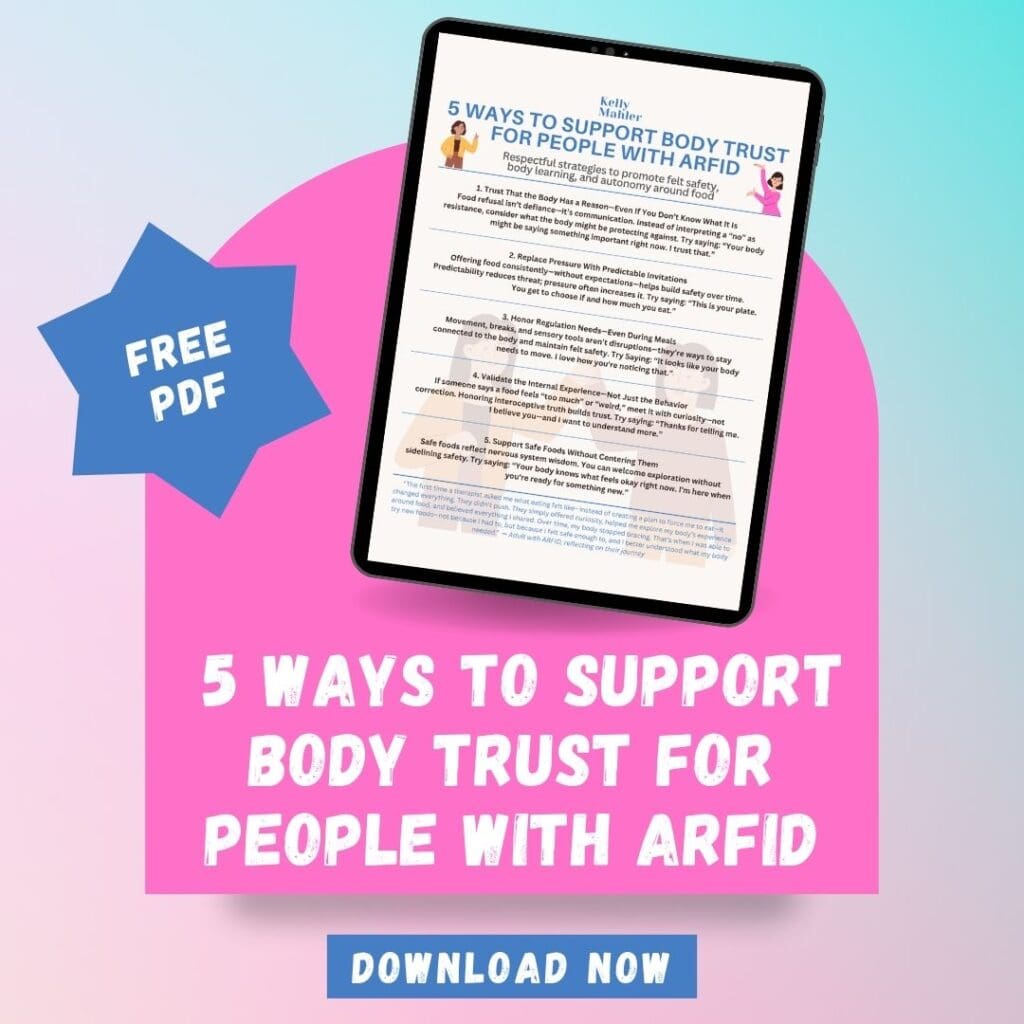
Free Download: 5 Ways to Support Body Trust for People with ARFID
When someone you care about struggles to eat, it can be deeply challenging to know how to offer support. This free 1-page guide offers five respectful, relationship-centered strategies to support eating without pressure. Rooted in interoception and body trust, each idea is designed to promote felt safety—an essential foundation for long-term shifts in how food is experienced.
These approaches not only support the nervous system to feel safer around food but also help uncover how the body feels and what it might need in those moments. Whether you’re a caregiver or professional, this handout offers compassionate language and curiosity-driven tools to explore—together, one step at a time.
Why Compliance-Based Feeding Strategies Can Backfire
Common feeding interventions—such as cognitive behavioral therapy, token boards, or “just one bite” exposure goals—are often built around external motivation and/or very little curiosity or validation of a person’s inner felt experience. These compliance-based strategies can unintentionally cause harm, especially for people with ARFID.
Why?
They invalidate the real, body-based experiences of discomfort or fear
They encourage masking and ignoring interoceptive cues
They may condition individuals to dissociate from their bodies to meet expectations
These strategies often further derail the interoceptive experience. They teach someone to ignore what their body is telling them in order to meet someone else’s demand—and that can be deeply damaging.
This matters because avoidant restrictive food intake isn’t simply about behavior. It’s often a response to internal signals that are unreliable. For example, someone may avoid eating certain foods because interoceptive cues—like pain, nausea, or sensory overwhelm—are too intense or unpredictable. Others might not feel hunger or fullness until they are in extreme states—the dysregulation making it hard to meet the body’s needs effectively.
Instead of external control, people with ARFID need affirming support that prioritizes felt safety, inner curiosity, and body trust. Interoception helps re-center their internal experience, offering insight into distress and discomfort while supporting more comfortable and empowered relationships with food.
An Interoception Approach to ARFID and Feeding Differences
Feeding differences aren’t one-size-fits-all. An affirming interoception-based approach to ARFID involves:
Recognizing that food can feel a certain way to the nervous system—it is not a choice, but an automatic response.
Exploring the underlying factors of feeding differences (including interoception, but also sensory, motor, emotional, etc.).
Helping a person understand their own unique interoceptive experience, including how their body feels and what it needs for felt safety.
Creating eating environments that support a regulated and safe feeling body.
Validating what the body dictates as food preferences and honoring safe foods.
Letting go of rigid definitions of progress or health. For example, discussing with a medical professional the use of specific nutritional supplements if food intake is resulting in nutritional deficiencies.
How Interoception Can Help People with ARFID Eating Disorder
In many traditional eating disorder treatment models, interoception is overlooked. But growing evidence—and lived experience—suggests that restoring a connection to internal signals is key to long-term support and self-trust.
Interoception provides two critical insights: it helps us understand what someone may be experiencing now (like distress, fear, or sensory mismatch), and it gives us a pathway toward more regulated, comfortable eating experiences over time.
What matters most is supporting the person with inner curiosity and validation—not fixing the food. In this model, interoceptive reconnection is not about demanding change—it’s about empowering people to understand, regulate, and advocate for what their bodies need.
These two courses explore neuro affirming approaches to supporting individuals with ARFID and feeding challenges through the lens of interoception, body trust, and lived experience. Led by Kelly Mahler and Naureen Hunani, the series helps professionals, caregivers, and individuals better understand how feeding experiences are shaped by sensory differences, trauma, anxiety, and societal expectations. Participants learn practical, compassionate strategies that prioritize safety, autonomy, and trust over compliance-based feeding practices.
While this page focuses on ARFID, interoception differences are also relevant in eating disorders (ED) like anorexia nervosa and bulimia nervosa. In these conditions, body signals such as hunger, fullness, or emotional distress may be muted, misread, or overridden. This disconnect can contribute to restrictive behaviors, binge-purge cycles, or a lack of attunement to the body’s needs.
Rebuilding interoceptive awareness—gently and without pressure—can help support more regulated and compassionate relationships with food. For autistic individuals, whose sensory and neurological experiences are often misunderstood, interoception work is especially important—but often left out of traditional treatment models.
To dive deeper into this intersection, check out our on-demand course Autism and Eating Disorders: Dying to Be Thin, co-taught with autistic advocate Kim Clairy. The course explores current research and offers practical tools for adapting ED care to better honor autistic neurology.
People with ARFID Are Not Picky Eaters: Hear It From Them!
In many traditional eating disorder treatment models, interoception is overlooked. But growing evidence—and lived experience—suggests that restoring a connection to internal signals is key to long-term support and self-trust.
ARFID is so often misunderstood as “picky eating,” but the reality is far more complex and deeply rooted in the body. Avoidant/Restrictive Food Intake Disorder (ARFID) is not about food preferences—it’s about how the nervous system, senses, and internal body signals respond to the eating experience itself.
Through a survey of more than 70 people who identify as having ARFID, my colleague Naureen Hunani and I heard powerful stories of pain, fear, and misunderstanding. Many participants shared experiences of physical discomfort while eating—like reflux, migraines, and nausea—and the frustration of being dismissed or disbelieved by professionals. These experiences highlight a crucial truth: ARFID is a body-based, sensory, and interoceptive condition that requires compassionate, validating support—not pressure to “just try new foods.”
Read The Experiences of People with ARFID
What people with ARFID want most is to be believed, understood, and given autonomy over their own eating experiences. Every voice in our research emphasized the importance of felt safety and choice—deciding what, when, and how they eat without judgment. Sensory differences play a huge role, from textures and smells to the sounds and visuals of food, making the act of eating overwhelming for many.
When we approach ARFID through the lens of interoception, we can support individuals in rebuilding trust with their bodies and creating environments that feel safe and predictable. True progress happens not through fixing or forcing, but through curiosity, respect, and the belief that every body’s experience with food deserves to be honored.
Whether you’re navigating an ARFID eating disorder, supporting someone with feeding differences, or seeking more compassionate eating disorder treatment, interoception offers a vital, often overlooked piece.
Interoception—the ability to notice and make meaning of internal body signals like hunger, fullness, nausea, or anxiety—can help people feel safer in their bodies and more understood in their identity with food.
Explore our affirming interoception resources—including courses, tools, and free downloads—designed to support autonomy, body trust, and felt safety. Every moment of curiosity is a step toward connection.
Sign up for our Monthly Newsletter and never miss a blog post again.
"*" indicates required fields
Cookie Consent
We use cookies to improve your experience on our site. By using our site, you consent to cookies.
Cookie Preferences
Manage your cookie preferences below:
Essential cookies enable basic functions and are necessary for the proper function of the website.
Name
Description
Duration
wc_client
Used by WhatConverts to store visitor and client tracking data including referral source, visit details, and visitor ID. Used for lead attribution and connecting marketing sources to conversions.
6 months
Cookie Preferences
This cookie is used to store the user's cookie consent preferences.
30 days
CloudFlare provides web performance and security solutions, enhancing site speed and protecting against threats.
Whether a CAPTCHA or Javascript challenge has been solved.
session
__cfseq
Sequence rules uses cookies to track the order of requests a user has made and the time between requests and makes them available via Cloudflare Rules. This allows you to write rules that match valid or invalid sequences. The specific cookies used to validate sequences are called sequence cookies.
session
cf_ob_info
The cf_ob_info cookie provides information on: The HTTP Status Code returned by the origin web server. The Ray ID of the original failed request. The data center serving the traffic
session
cf_chl_rc_ni
These cookies are for internal use which allows Cloudflare to identify production issues on clients.
session
cf_chl_rc_m
These cookies are for internal use which allows Cloudflare to identify production issues on clients.
session
__cfruid
Used by the content network, Cloudflare, to identify trusted web traffic.
session
__cf_bm
Cloudflare's bot products identify and mitigate automated traffic to protect your site from bad bots. Cloudflare places the __cf_bm cookie on End User devices that access Customer sites that are protected by Bot Management or Bot Fight Mode. The __cf_bm cookie is necessary for the proper functioning of these bot solutions.
session
__cflb
When enabling session affinity with Cloudflare Load Balancer, Cloudflare sets a __cflb cookie with a unique value on the first response to the requesting client. Cloudflare routes future requests to the same origin, optimizing network resource usage. In the event of a failover, Cloudflare sets a new __cflb cookie to direct future requests to the failover pool.
session
_cfuvid
The _cfuvid cookie is only set when a site uses this option in a Rate Limiting Rule, and is only used to allow the Cloudflare WAF to distinguish individual users who share the same IP address.
session
cf_use_ob
The cf_use_ob cookie informs Cloudflare to fetch the requested resource from the Always Online cache on the designated port. Applicable values are: 0, 80, and 443. The cf_ob_info and cf_use_ob cookies are persistent cookies that expire after 30 seconds.
session
__cfwaitingroom
The __cfwaitingroom cookie is only used to track visitors that access a waiting room enabled host and path combination for a zone. Visitors using a browser that does not accept cookies cannot visit the host and path combination while the waiting room is active.
session
cf_chl_rc_i
These cookies are for internal use which allows Cloudflare to identify production issues on clients.
session
Google Tag Manager simplifies the management of marketing tags on your website without code changes.
Name
Description
Duration
cookiePreferences
Registers cookie preferences of a user
2 years
td
Registers statistical data on users' behaviour on the website. Used for internal analytics by the website operator.
session
Popup Maker is a WordPress plugin used to display on-site popups (e.g., opt-ins, announcements, promotions). It sets first-party cookies to remember whether a specific popup has already been shown or closed, preventing it from repeatedly appearing to the same visitor.
Tracks whether a specific popup (post ID 183035) has already been shown to, or dismissed by, the visitor, so it can control display frequency/conditions (e.g., "don't show again," "show once per session")
5 days
WhatConverts is a call tracking and lead intelligence platform that captures and attributes leads — including phone calls, form submissions, and chat interactions — to the marketing campaigns, keywords, and traffic sources that generated them. It uses dynamic number insertion (DNI) to swap phone numbers on the page in real time, enabling accurate tracking of which marketing efforts drive inbound calls and conversions.
Stores the landing page URL a visitor first entered your site on, so WhatConverts can attribute calls, form submissions, and chats back to that specific landing page/campaign for lead-source reporting
12 months
WooCommerce is a customizable eCommerce platform for building online stores using WordPress.
Name
Description
Duration
cookies.js
This is a JavaScript cookie library used by WooCommerce to store and retrieve essential store cookies in the browser (such as cart and session data). It is not a tracking cookie and does not collect analytics or marketing information on its own.
Session
woocommerce_dismissed_suggestions__
Count of suggestion dismissals, if enabled.
1 month
woocommerce_cart_hash
Helps WooCommerce determine when cart contents/data changes.
session
woocommerce_items_in_cart
Helps WooCommerce determine when cart contents/data changes.
session
wp_woocommerce_session_
Contains a unique code for each customer so that it knows where to find the cart data in the database for each customer.
2 days
woocommerce_recently_viewed
Powers the Recent Viewed Products widget
session
store_notice
Allows customers to dismiss the Store Notice.
session
woocommerce_snooze_suggestions__
Allows dashboard users to dismiss Marketplace suggestions, if enabled.
2 days
Statistics cookies collect information anonymously. This information helps us understand how visitors use our website.
Clarity is a web analytics service that tracks and reports website traffic.
ID used to identify users for 24 hours after last activity
24 hours
_gat
Used to monitor number of Google Analytics server requests when using Google Tag Manager
1 minute
__utmb
Used to distinguish new sessions and visits. This cookie is set when the GA.js javascript library is loaded and there is no existing __utmb cookie. The cookie is updated every time data is sent to the Google Analytics server.
30 minutes after last activity
__utmc
Used only with old Urchin versions of Google Analytics and not with GA.js. Was used to distinguish between new sessions and visits at the end of a session.
End of session (browser)
__utmz
Contains information about the traffic source or campaign that directed user to the website. The cookie is set when the GA.js javascript is loaded and updated when data is sent to the Google Anaytics server
6 months after last activity
__utmv
Contains custom information set by the web developer via the _setCustomVar method in Google Analytics. This cookie is updated every time new data is sent to the Google Analytics server.
2 years after last activity
__utmx
Used to determine whether a user is included in an A / B or Multivariate test.
18 months
_ga
ID used to identify users
2 years
_gali
Used by Google Analytics to determine which links on a page are being clicked
30 seconds
_ga_
ID used to identify users
2 years
_gac_
Contains information related to marketing campaigns of the user. These are shared with Google AdWords / Google Ads when the Google Ads and Google Analytics accounts are linked together.
90 days
__utma
ID used to identify users and sessions
2 years after last activity
__utmt
Used to monitor number of Google Analytics server requests
10 minutes
Shareaholic provides social sharing buttons and related-content widgets. It uses cookies to recognize visitors across sessions and sites for engagement tracking and content recommendations.
Cross-domain session encryption/identifier used by Shareaholic's share buttons/related-content widget to recognize returning visitors and sync engagement data across sites using the service
10 years
SourceBuster is used by WooCommerce for order attribution based on user source.
Name
Description
Duration
tk_qs
Stores queries/events queued to be sent to Jetpack's first-party analytics platform; works together with the companion tk_ai cookie (anonymous visitor ID) for tracking searches (Jetpack Instant Search) and WooCommerce Analytics activity
-
sbjs_first
Traffic origin information for the visitor’s first visit to your store (only applicable if the visitor returns before the session expires)
session
sbjs_current
Traffic origin information for the visitor’s current visit to your store
session
sbjs_first_add
Timestamp, referring URL, and entry page for your visitor’s first visit to your store (only applicable if the visitor returns before the session expires)
session
sbjs_current_add
Timestamp, referring URL, and entry page for your visitor’s current visit to your store
session
sbjs_migrations
Technical data to help with migrations between different versions of the tracking feature
session
sbjs_session
The number of page views in this session and the current page path
30 minutes
sbjs_udata
Information about the visitor’s user agent, such as IP, the browser, and the device type
session
Marketing cookies are used to follow visitors to websites. The intention is to show ads that are relevant and engaging to the individual user.
Facebook Pixel is a web analytics service that tracks and reports website traffic.
Google uses cookies for advertising, including serving and rendering ads, personalizing ads (depending on your ad settings at g.co/adsettings), limiting the number of times an ad is shown to a user, muting ads you have chosen to stop seeing, and measuring the effectiveness of ads.
90 Days
FPGCLGB
Google uses cookies for advertising, including serving and rendering ads, personalizing ads (depending on your ad settings at g.co/adsettings), limiting the number of times an ad is shown to a user, muting ads you have chosen to stop seeing, and measuring the effectiveness of ads.
90 Days
FPGCLAW
Google uses cookies for advertising, including serving and rendering ads, personalizing ads (depending on your ad settings at g.co/adsettings), limiting the number of times an ad is shown to a user, muting ads you have chosen to stop seeing, and measuring the effectiveness of ads.
90 Days
__Secure-1PSIDTS
Targeting cookie. Used to create a user profile and display relevant and personalised Google Ads to the user.
2 years
__Secure-1PAPISID
Targeting cookie. Used to create a user profile and display relevant and personalised Google Ads to the user.
2 years
__Secure-3PSID
Targeting cookie. Used to profile the interests of website visitors and display relevant and personalised Google ads.
2 years
Conversion
Google uses cookies for advertising, including serving and rendering ads, personalizing ads (depending on your ad settings at g.co/adsettings), limiting the number of times an ad is shown to a user, muting ads you have chosen to stop seeing, and measuring the effectiveness of ads.
90 days
_gcl_aw
Google uses cookies for advertising, including serving and rendering ads, personalizing ads (depending on your ad settings at g.co/adsettings), limiting the number of times an ad is shown to a user, muting ads you have chosen to stop seeing, and measuring the effectiveness of ads.
90 Days
_gcl_gs
Google uses cookies for advertising, including serving and rendering ads, personalizing ads (depending on your ad settings at g.co/adsettings), limiting the number of times an ad is shown to a user, muting ads you have chosen to stop seeing, and measuring the effectiveness of ads.
90 Days
_gcl_gb
Google uses cookies for advertising, including serving and rendering ads, personalizing ads (depending on your ad settings at g.co/adsettings), limiting the number of times an ad is shown to a user, muting ads you have chosen to stop seeing, and measuring the effectiveness of ads.
90 Days
__Secure-1PSID
Targeting cookie. Used to create a user profile and display relevant and personalised Google Ads to the user.
2 years
__Secure-1PSIDCC
Targeting cookie. Used to create a user profile and display relevant and personalised Google Ads to the user.
2 years
__Secure-3PAPISID
Profiles the interests of website visitors to serve relevant and personalised ads through retargeting.
2 years
AEC
AEC cookies ensure that requests within a browsing session are made by the user, and not by other sites. These cookies prevent malicious sites from acting on behalf of a user without that user's knowledge.
6 months
ADS_VISITOR_ID
Cookie required to use the options and on-site web services
2 months
__Secure-3PSIDCC
Targeting cookie. Used to create a user profile and display relevant and personalised Google Ads to the user.
2 years
__Secure-3PSIDTS
Targeting cookie. Used to create a user profile and display relevant and personalised Google Ads to the user.
2 years
PixelYourSite integrates Meta (Facebook) Pixel and Conversions API tracking with WordPress. Its advanced form tracking feature captures form field data (such as email, phone, and name) as visitors interact with forms, to improve ad conversion match quality with Meta.
Captures form field data (email, phone number, first/last name, and any custom fields you've configured) as visitors type into form inputs — even if they never submit the form. This data is attached to Meta/Facebook Conversions API (CAPI) events to improve Event Match Quality (EMQ) for ad tracking/attribution.