


Interoception and co-regulation are closely connected processes that support nervous system regulation and emotional regulation.
Interoception is the sense of internal body signals that indicate thirst, stress, pain, overwhelm, comfort, and more. Co-regulation is the supportive process where nervous systems move toward regulation together through connection, responsiveness, and shared adjustment. Interoception helps us notice what the body is experiencing, and co-regulation helps us respond in ways that support recovery and participation in daily life.
Interoception and co-regulation are essential for understanding behavior and providing emotional regulation support across home, school, and therapy settings. When a person melts down, shuts down, or refuses to participate, it can feel like everything is falling apart, especially when everyone is often trying their best. Many adults are taught to “fix the behavior,” but this approach focuses only on outward behavior and not the body experience underneath it. It often assumes a behavior is intentional, which drives methods of compliance and external control.
A different starting point is curiosity about what the body might be feeling.
When adults shift from asking “How do I stop this behavior?” to wondering “What might this body be experiencing right now, and what might help it feel better?” the conversation begins to change.
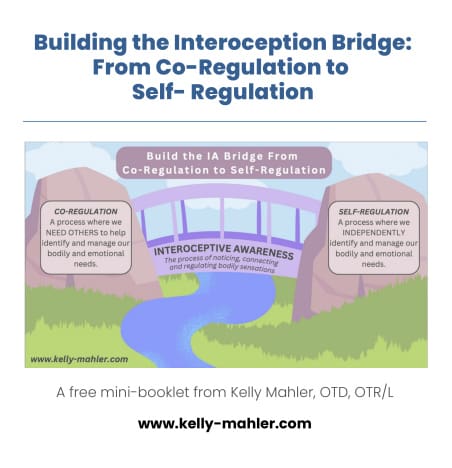
From Co-Regulation to Self-Regulation: How Body Awareness Develops Over Time
All humans are born needing co-regulation. From the beginning of life, infants notice comfort and discomfort in their bodies, even if they don’t yet understand what those signals mean.
Because infants cannot put words to these experiences, they communicate through crying, movement, facial expressions, or shifts in their state. These expressions signal that the body needs support.
Caregivers respond by observing, validating, and offering possible supports—feeding, rocking, dimming lights, offering closeness, changing a diaper, and more. When one strategy doesn’t help, they adjust and try again. Over time, the infant’s body returns to comfort through this shared process.
These moments do more than meet immediate needs. They begin to build an understanding that body signals matter, that those signals will be responded to, and that certain actions can help the body feel better.
Through repeated experiences of co-regulation, many young people begin to:
- Notice more specific body signals
- Understand what those signals might mean
- Discover what helps their body move toward comfort
This process highlights how co-regulation strategies support interoception development and lay the groundwork for self-regulation.
Free Download
You might be asking for someone to self-regulate without interoceptive awareness in place.
This short guide explains what’s often missing and how to support it through co-regulation.

Are We Expecting Self-Regulation Without Enough Co-Regulation?
Self-regulation is often a major focus in therapy and schools (especially in IEP goals). It is typically described as the ability to manage emotions, stay calm, or use strategies during difficult moments.
But self-regulation depends on a set of internal skills that are often invisible. A person must be able to:
- Notice growing discomfort in their body
- Understand what those signals might mean
- Communicate or describe what feels wrong
- Explore what might help the body feel better
- Tolerate uncertainty while trying different strategies
- Reconnect to their body after stress
All of these rely on interoceptive awareness, the ability to notice, understand, and respond to internal body signals.
When interoceptive awareness is not fully developed, expectations like “use your strategies,” “take a break,” or “calm down” can be unfair and unhelpful.
What a person often needs is not more self-regulation demands, but rather more co-regulation strategies, more supportive adults staying curious and present, and offering more options while the body settles. This is especially important when considering co-regulation for neurodivergent learners, whose interoceptive awareness and sensory experiences may differ.
For a deeper explanation, read my blog: The Power of Co-Regulation.
Interoception and Co-Regulation at Home and School: A Simple 3-Step Plan
Even the most loving co-regulation at home cannot fully buffer environments that expect compliance before understanding.
When expectations for self-regulation come before these foundational skills are in place, compliance culture can begin to creep in. The person’s “behavior” may be labeled as defiant, challenging, or oppositional. The focus shifts toward controlling behavior rather than understanding the body experience underneath it.
There is a quiet irony here.
Many approaches aimed at improving “behavior” rely on compliance: following directions, stopping a behavior, or meeting external expectations. But these approaches often bypass the very skills a person needs to regulate their body.
Compliance asks for behavior change without necessarily supporting this internal learning.
In fact, in most cases, compliance can even move a person further away from their body signals, encouraging them to override discomfort, ignore internal cues, or prioritize external expectations over what their body is communicating. They are encouraged to suppress the body’s needs to please others.
When we shift away from compliance and make co-regulation the priority, interoception learning can come back online, and we can build the foundation for meaningful self-regulation.
Co-Regulation Strategies: Body-Based Regulation Strategies That Support Nervous System Regulation
When behavior escalates, co-regulation focuses less on controlling behavior and more on responding to what the body may need. Below are co-regulation strategies to guide this process:

Observe
Notice signals of comfort and discomfort.
Examples:
- “I notice your hands are tight.”
- “I see your body moved away.”
- “Your voice got louder.”

Validate
Validation communicates belief and safety.
Examples:
- “That makes sense.”
- “I’m here.”
- “Your body is working hard right now.”

Support
Offer body-based regulation strategies that can support comfort and safety.
Examples:
- Pressure (squeeze pillow, hug pillow)
- Movement (walk, stretch)
- Snack or drink
- Sensory changes (headphones, quieter space)
- Proximity or space

Repair
If something doesn’t help, apologize. Repair keeps the relationship safe.
Examples:
- “Sorry, I misunderstood.”
- “Oops! Your body might need something different.”
- “Guessed wrong! I’m trying. Let’s figure this out.”

Try Again
Adjust and try another option. Stay curious and connected as you figure out what helps.

Tools to Support Interoception & Co-Regulation in Everyday Life
Understanding body signals and supporting regulation takes more than strategies in the moment. It often requires structured opportunities to explore, notice, and learn how the body works, especially outside of stressful situations.
If you’re looking for practical co-regulation tools and ways to build interoception into daily life, these resources can help:
- Noticing My Body Signals: A Science Lab Adventure: A playful, hands-on way to explore body signals and begin building interoceptive awareness.
- The Interoception Curriculum Bundle: A structured, step-by-step framework designed to support interoception learning through guided exploration and co-regulation.
- On-Demand Course: Co-Regulation & Sensory Safety—The Foundation of Successful Participation: A deeper dive into interoception and co-regulation, including nervous system support, and environmental safety.
- Early Interoception Communication Course: Learn how to recognize and respond to body-based communication, especially for early or non-speaking communicators.
FAQs about Interoception and Co-Regulation
If you’re wondering “Am I doing this right?” or “What do I say in the moment?” you’re not alone. These common questions can help you move from behavior-fixing to body-informed support.
What Is Co-Regulation?
What Is Co-Regulation?
Co-regulation is what happens when two nervous systems work together to help the body move toward safety and comfort. A regulated adult notices body signals, responds with curiosity and support, and adjusts based on what the other person’s body is showing.
Over time, these experiences help people understand what their body signals mean.
What Are Co-Regulation Strategies?
What Are Co-Regulation Strategies?
Co-regulation strategies are ways adults respond to body signals when someone is overwhelmed or uncomfortable.
Examples may include movement, sensory adjustments, pressure, environmental changes, or simply staying nearby so the person is not alone while their body settles.
The goal is not controlling behavior—it is helping the body move toward comfort and safety.
Why Is Co-Regulation Important for Neurodivergent Learners?
Why Is Co-Regulation Important for Neurodivergent Learners?
Many neurodivergent people experience differences in interoception and sensory processing. When body signals are hard to notice or interpret, stress can escalate quickly.
Co-regulation helps adults respond to those signals with curiosity and support so the person’s body can recover and learn what helps.
When Should Interoception Be Practiced?
When Should Interoception Be Practiced?
Interoception learning works best when the body is already feeling relatively comfortable.
Exploring body signals during calm or neutral moments helps people notice patterns in their body and discover what supports comfort, so those insights are easier to access during stressful moments later.
How Are Interoception and Co-Regulation Connected?
How Are Interoception and Co-Regulation Connected?
Interoception helps us notice internal body signals, while co-regulation provides the support needed to respond to those signals. Together, they create the foundation for emotional regulation support and meaningful self-regulation.