

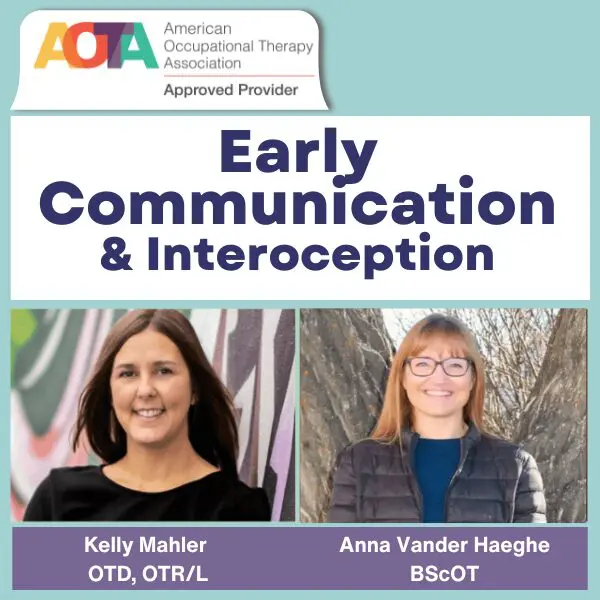
On-Demand: Interoception & Early Communication: Supporting Preschoolers, Non-Speaking Children & Beyond
$139.00 USD
3.5 hours of content! When children don’t yet have the words to explain what they’re feeling, adults are often left guessing and interoception expressions are easily misread as “challenging behavior.” This course offers an interoception-informed framework with practical scripts, visuals, and communication tools that support curious, respectful guesswork while keeping the child actively involved in meaning-making. You’ll learn how to respond to automatic interoception expressions (like crying, clinging, or refusing) and how to support a natural progression toward more reflective communication (such as choosing sensory supports or expressing pain with a device). All registrants will receive access to a light tech Interoception Communication Board and the all new Interoception Response Cards.

Kelly Mahler is an AOTA Provider of professional development. Course Approval ID #15157. This Distance Learning-Independent is offered at .35 CEUS, introductory, OT Service Delivery and Foundational Knowledge. The assignment of AOTA CEUs does not imply endorsement of specific course content, products, or clinical procedures by AOTA.
Ready to get started with the course?
Group Discount Available:
2-5 Participants: 15% Discount
6+ Participants: 25% Discount
*Be sure to click the group option when adding courses to your cart, and the discount will apply automatically!
Description
This course includes:
-
- 3.5 hours of live instruction with Kelly & Anna (120 minutes of content + 60 minutes Q&A)
- 6 months of access to the recording
- Exclusive downloadable resources, including:
- The Interoception Communication Supporter Cards
- The Responsive Interoception Communication Map
- The Inner Core Board is provided in the training and different ways to access it are discussed within the course.
- Personalized certificate of completion
- While this course is excellent for a wide variety of attendees, this course is approved for 0.35 AOTA CEUs (3.5 contact hours)
Course Description:
Young children communicate long before they have words, and for many especially for not-yet-speaking or non-speaking children their bodies are their first and most reliable communication system. Yet too often, these early expressions are misunderstood, dismissed, or corrected through compliance-based practices, leaving children without the validation they need to grow deeper communication skills.
This live course introduces an interoception-first framework for understanding early communication one that helps adults recognize, honor, and build upon the communication children are already offering through their bodies.
Together, we will explore the two types of interoception communication:
Automatic Interoception Communication
A child’s natural, instinctive expressions of their inner experience: crying, leaning in, clinging, hiding, freezing, covering ears, screaming.
These are not misbehaviors. They are communication.
When adults respond with curiosity and validation, children learn:
“My inner world makes sense. What I express matters. I am believed.”
This is the foundation from which interoceptive awareness and all later communication grows.
Reflective Interoception Communication
A child’s emerging, intentional expressions of what their body is experiencing: choosing from picture cards, guiding an adult toward a need, selecting sensory supports, using AAC, etc. Reflective communication requires:
- effort
- vulnerability
- a sense that you will be believed
It develops when Automatic Interoception Communication has been consistently validated not corrected or pathologized.
The Compliance Dilemma
Many early childhood settings unintentionally use compliance-based responses:
“you’re fine,”
“stop crying,”
“quiet hands,”
“use your words.”
But when a child’s automatic expressions are treated as misbehavior (e.g., attention-seeking, escape/avoidance, oppositional, defiant, naughty) they learn their inner experience is unwanted and wrong.
Why put effort into more advanced reflective communication when your body’s first language wasn’t believed?
What you’ll learn:
How to identify and honor Automatic Interoception Communication
- What early expressions look like
- Why they matter
- How to recognize wellness messaging that lacks rigorous scientific evidence
- A clear framework for exploring the deep why while involving the child in the meaning-making process every step of the way
- Concrete response scripts that validate, not override, a child’s inner experience
How Reflective Interoception Communication emerges and how to support it
- What makes reflective communication effortful and risky for many early communicators
- The conditions children need before trying new forms of expression
- How to develop the body knowledge needed to for reflecting and communicating what the body needs
- How to support early reflective attempts with visuals, cards, AAC, simple choices, and co-regulated prompting
- How to involve the child in the meaning-making process without forcing “use your words”
Practical, ready-to-use strategies for early communicators
- An Automatic → Reflective Interoception Communication framework that guides adults in supporting expression of inner feels
- Interoception Response Cards to explore the meaning behind non-spoken expressions and validate a child’s inner experience
- Interoception Communication Boards to support non-spoken forms of expression
- Specific scripts adults can use to communicate curiosity and actively involve children in meaning-making (what to say—and what to avoid)
- Play-based, preschool-friendly activities for noticing body sensations in everyday routines
- How to use The Interoception Curriculum (IC) with early communicators, what to focus on first, and how to embed IC activities into circle time, centers, play, and transitions
Who this course is for:
You will benefit from this course if:
- You support preschoolers, toddlers, or non-speaking children of any age
- You are an Occupational Therapy Practitioner, SLP, educator, mental health provider, childcare professional, or caregiver
- You want to replace compliance-based techniques with curiosity-based, neuro affirming approaches
- You want to deepen your understanding of interoception in early communication
- You want practical tools you can use the next day
- You want to strengthen connection, regulation, and communication all through an interoception-first lens
So, who are we?:
We’ve been in each other’s professional orbit- and good friends-for nearly eight years now, and our collaboration has always been fueled by a shared love of thinking very deeply about our work. We both have detailed brains (with maybe a little overanalyzing along the way), which means our conversations tend to linger, loop back, and zoom in until things actually make sense for real people in real settings.
Over the years, we’ve traded ideas, questioned assumptions, learned from what didn’t work, and celebrated the moments when things finally clicked for early communicators and the adults supporting them. This course is the product of that long-running, thoughtful dialogue, grounded in our curiosity, shaped by experience, and built for those who want to go beyond surface strategies to truly understand and support early communication.
 Anna Vander Haeghe: Curious, passionate and focused, I have loved my journey of diving into interoception and how that relates to our experiences as humans. Weaving interoception-based practice into my work as an Occupational Therapist in Alberta, Canada has been life-changing for my students and co-workers. I have been an OT for 25 years working in a small rural community serving the entire live span. 12 years ago I shifted to focus supporting children from preschool to high school. I have mentored therapists around the world in ways to modify interoception work for our diverse students and look forward to sharing my experiences with you.
 Kelly Mahler: I am a fiery and passionate person that loves to crunch pinecones, cuddle with my 2 Corgi puppies and cook (sometimes poorly) with my family. I earned a Doctorate in Occupational Therapy from Misericordia University, Dallas, PA and have been an occupational therapist for 24 years, serving school-aged children and adults. I’m winner of multiple awards including the 2020 American Occupational Therapy Association Emerging and Innovative Practice Award & a Mom’s Choice Gold Medal. I am an international speaker and enjoy presenting on topics related to the twelve resources I’ve authored including The Interoception Curriculum.
The Official Stuff:
- Course Level: Intermediate
- AOTA Areas: Foundational Knowledge, OT Service Delivery, Professional Issues
- CE Learning Outcomes: By the end of this course, participants will be able to:
- Explain how interoception, nervous system state, sensory experiences, and felt safety influence early communication and participation.
- Analyze early communication behaviors through an interoception-informed, neuro-affirming lens to identify underlying needs and supports.
- Apply interoception-informed strategies to support communication, regulation, and participation for early communicators across routines and environments
- Contact Hours: This course is worth 3.5 contact hours or 0.35 AOTA CEUs.
- Completion Requirements: To receive credit and certificate for this course you must listen to the course in its entirety, pass the accompanying assessment with an 80% or higher and complete a course evaluation. With the exception of AOTA-approved CEUs, this course is not approved or affiliated with any governing bodies that award continuing education credits, so continuing education credits are not guaranteed.
- ADA/Section 504: If you require special accommodations, please contact us at [email protected]
- Kelly Mahler is an Approved Provider of Continuing Education for occupational therapists and occupational therapy assistants by the American Occupational Therapy Association. The assignment of AOTA CEUs does not imply endorsement of specific course content, products, or clinical procedures by AOTA.
- Speaker Disclosures:
- Financial: Kelly Mahler and Anna Vander Haeghe have received royalty payments from Mahler OT related to this course.
- Non-Financial: Kelly Mahler and Anna Vander Haeghe have no relevant non-financial relationships to disclose.
Questions: Contact us at [email protected].
Additional information
| Course Credits | AOTA Course, On-Demand |
|---|