

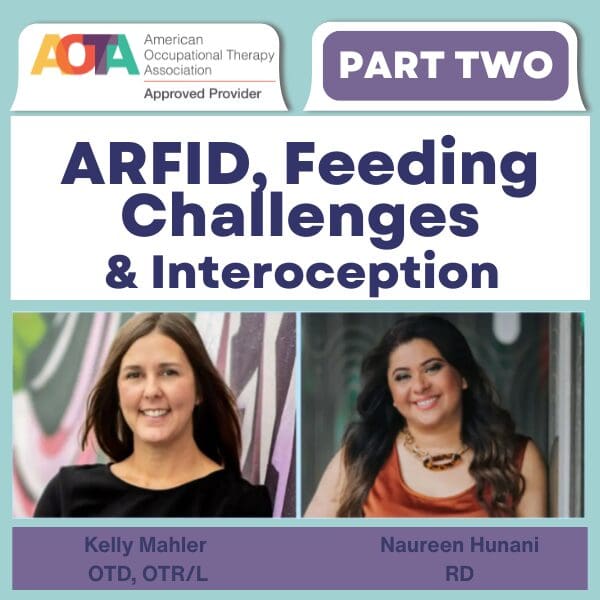
On-Demand Course: ARFID & Feeding Challenges: Injustice, Interoception & the Power of Being Believed—An Advanced Conversation
$89.00 USD
This is part 2 of a 2-part course. This advanced on-demand course builds on Part 1’s foundation of interoception, body trust, and affirming ARFID care, going deeper into the places most trainings never touch. We’ll name the injustices that surround feeding, from being dismissed as experts in one’s own experience (epistemic injustice) to lacking the concepts and language needed to be understood (hermeneutical injustice). Together, we’ll also explore how rejection sensitivity and interoception predictions shape ARFID, and how being believed becomes the foundation for change. Practical strategies will guide you in shifting the feeding narrative toward justice, credibility, and embodied trust. Learn more about Part 1 here.

Description
This on-demand course includes:
- 2-hours instruction with Naureen & Kelly (approximately 90 minutes of content + 30 minutes of Q&A)
- 6-months unlimited access to the recorded version
- Access to 3 exclusive downloadable resources
- Personalized certificate of completion
Course Description:
This is Part 2 of our ARFID and Interoception Course Series. Learn more about Part 1 here.
ARFID and other feeding challenges can’t be understood through behavior alone. They are deeply tied to interoception, trauma, and the experience of injustice. In Part 1, we built a foundation by exploring affirming approaches to interoception, feeding, and ARFID. In Part 2, we’re going deeper.
This course looks at how people’s lived experiences of ARFID are often silenced, doubted, or framed through deficit-based models that erase the truth of what they feel in their bodies. We’ll explore how interoception predictions about eating are formed and updated, and why supporting signals like fear, disgust, and anxiety is central to body trust.
We’ll also name two injustices that are rarely addressed in feeding spaces:
- Epistemic injustice—when someone’s feeding experiences are dismissed or doubted because they are not seen as credible.
- Hermeneutical injustice—when marginalized groups are denied the capacity to create language for their experiences, leaving people without the words to describe what’s happening in their bodies in ways that others can understand or honor.
At its heart, this course is about shifting the feeding conversation: What would change if safety, belief, and body trust came before everything else?
Agenda:
- 15 minutes ARFID topics from people with ARFID
- 75 minutes Practical Applications and Strategies
- 30 minutes filmed Q&A
What you’ll learn:
-
- How interoception predictions about eating are formed—and how to update them over time
- How to support body signals of fear, disgust, and anxiety around eating
- How rejection sensitivity disrupts body trust and can make food feel tied to judgment, pressure, or conditional acceptance
- How epistemic injustice (being seen as less credible) affects whose feeding experiences are believed
- How hermeneutical injustice (lacking language to describe experience) impacts interoception and eating
- Why safety in feeding can’t be promised with words—and how to earn it by honoring signals and believing someone’s experience
- Practical strategies for building justice, credibility, and embodied trust
Who this course is for:
- You serve clients of any age experiencing feeding challenges and/or ARFID
- You are an Occupational Therapy Practitioner, Registered Dietician, Speech and Language Pathologist, Mental Health Provider, Educator, or Caregiver who wants to provide affirming, cutting-edge support
- You want to understand the deeper role of injustice, body trust, and interoception in feeding challenges
- You are a person with lived experience of feeding challenges/ARFID seeking affirming language, validation, and strategies that reflect your truth
So, who are we?:

More about Naureen: Naureen Hunani (she/her) is a multiply-neurodivergent registered dietitian with over 18 years of experience. She is the founder of RDs for Neurodiversity, a neurodiversity-informed online continuing education platform and community for dietitians and helping professionals.
She has a private practice in Montreal, Canada, where she supports people struggling with various feeding and eating challenges through a trauma-informed, weight-inclusive and anti-oppressive approach. She is the creator of the Neurodiversity Affirming Model®, a framework developed to disrupt, challenge and dismantle the current oppressive models that exclude the feeding and eating experiences of neurodivergent and disabled people. Naureen has extensive experience working with neurodivergent children, adults and families. She has had the privilege to share her knowledge at national and international conferences. In 2023, she received ASAN’s Nothing About Us Without US Award. She is passionate about supporting pro-justice and weight-inclusive professionals striving to build liberatory practices.
 More about Kelly Mahler: I earned a Doctorate in Occupational Therapy from Misericordia University, Dallas, PA and have been an occupational therapist for 20 years, serving school-aged children and adults. I’m winner of multiple awards including the 2020 American Occupational Therapy Association Emerging and Innovative Practice Award & a Mom’s Choice Gold Medal. I am an international speaker and enjoy presenting on topics related to the twelve resources I’ve authored including:
- The Interoception Curriculum: A Step-by-Step Framework for Developing Mindful Self-Regulation-used in over 30 countries world wide
- Interoception Activity Cards
The Official Stuff:
- Course Level: Intermediate
- AOTA Areas: Foundational Knowledge, OT Service Delivery
- Prerequisites: None
- CE Learning Outcomes: By the end of this course, participants will be able to:
- Analyze how interoception predictions can influence eating experiences in individuals with ARFID.
- Analyze how forms of epistemic injustice (including testimonial and hermeneutical injustice) can influence the understanding and support of feeding challenges.
- Apply strategies that promote epistemic justice and support safe participation in the occupations of eating and feeding
- Instructional Methods: Lecture, slides, stories of lived experience/case studies
- Contact Hours: This course is worth 2.0 contact hours or 0.20 AOTA CEUs.
- Completion Requirements:To receive credit and certificate for this course you must listen to the course in its entirety, pass the accompanying assessment with an 80% or higher and complete a course evaluation. With the exception of AOTA-approved CEUs, this course is not approved or affiliated with any governing bodies that award continuing education credits, so continuing education credits are not guaranteed.
- ADA/Section 504: If you require special accommodations, please contact us at [email protected]
- Kelly Mahler is an Approved Provider of Continuing Education for occupational therapists and occupational therapy assistants by the American Occupational Therapy Association. The assignment of AOTA CEUs does not imply endorsement of specific course content, products, or clinical procedures by AOTA.
- Speaker Disclosures:
- Financial: Kelly Mahler and Naureen Hunani have received royalty payments from Mahler OT related to this course.
- Non-Financial: Kelly Mahler and Naureen Hunani have no relevant non-financial relationships to disclose.
Additional information
| Course Credits: | AOTA Course, On-Demand |
|---|