


If you’re a parent or caregiver of an autistic child or a child who struggles with self-regulation, you may already sense that demanding compliance isn’t actually helping. Maybe you’ve tried reward charts, countdowns, and firm boundaries, and something still feels off. Your child is stressed. You’re exhausted. And it doesn’t seem to be getting better.
I want you to know that there’s a different way. And it doesn’t mean giving up on expectations. It means starting from a place your child can work from.
Less compliance means shifting the focus away from demanding behavioral obedience and toward understanding what your child’s body and nervous system need in that moment. It’s a body-first approach that asks, “What does my child’s body need first?” before asking, “Why won’t my child just do this?”
Less compliance at home isn’t about lowering the bar. It’s about understanding what’s getting in the way first, and meeting your child in their body, not just their behavior.
What Does “Less Compliance at Home” Actually Mean?
This is one of the most common questions I get from parents, and I love it, because it tells me you’re already thinking critically about what your child really needs.
Less compliance at home doesn’t mean no expectations. It doesn’t mean your child gets to do whatever they want. What it does mean is this: when we lead with compliance demands, we’re often asking children to override what their body is telling them. We’re asking them to sit still when their nervous system is screaming to move. We’re asking them to stop crying when they don’t yet have the words or awareness to know what’s happening inside them.
When the body is dysregulated, compliance-based approaches can actually make things harder. Research shows that compliance pressure can interfere with a child’s ability to develop interoceptive awareness, which is their ability to notice and understand internal body signals like hunger, fatigue, anxiety, and overwhelm.
Here’s What a Less Compliance Approach Looks Like in Practice:
- Pausing before a demand to ask, “Is my child’s body in a state to respond right now?”
- Prioritizing your child’s body-based experience over behavioral output
- Supporting body awareness and internal signal recognition before expecting regulation
- Building trust and safety so your child can begin to self-understand and self-regulate
- Replacing control-first strategies with curiosity-first conversations
When children build genuine interoceptive awareness, the need for external compliance pressure often decreases naturally. They start to notice what they need. They start to communicate it. They start to regulate from the inside out.
That’s the goal.
Why Compliance-Based Approaches Can Backfire
I spent years working with children and adults as an occupational therapist before I understood this fully myself. So, I’m not here to make anyone feel guilty. Most of us were trained in compliance-based systems because that’s what has been dominant in behavior support for decades.
But here’s what I’ve learned and what the research increasingly supports. When we prioritize behavioral compliance over body awareness, we can inadvertently teach people to ignore their internal signals. Over time, that disconnection can show up as:
- Difficulty identifying and communicating emotions
- Meltdowns or shutdowns that seem to “come out of nowhere”
- Chronic stress and burnout
- Trouble with toileting, eating, sleeping, or other body-based needs
- Anxiety and avoidance patterns at home and school
These challenges are not a sign that your child isn’t trying. They’re often a sign that their interoceptive awareness hasn’t had the chance to develop in a supported way.
A less compliance-at-home approach shifts the focus. Instead of asking “How do I get my child to do what I need them to do,” we start asking “What is my child’s body telling them right now, and how can I help them notice that and respond to it?”
That shift changes everything.
Free Download: The Less Compliance Community Booklet
I put this booklet together because I wanted you to see what less compliance at home actually looks like in everyday life, not just in theory.
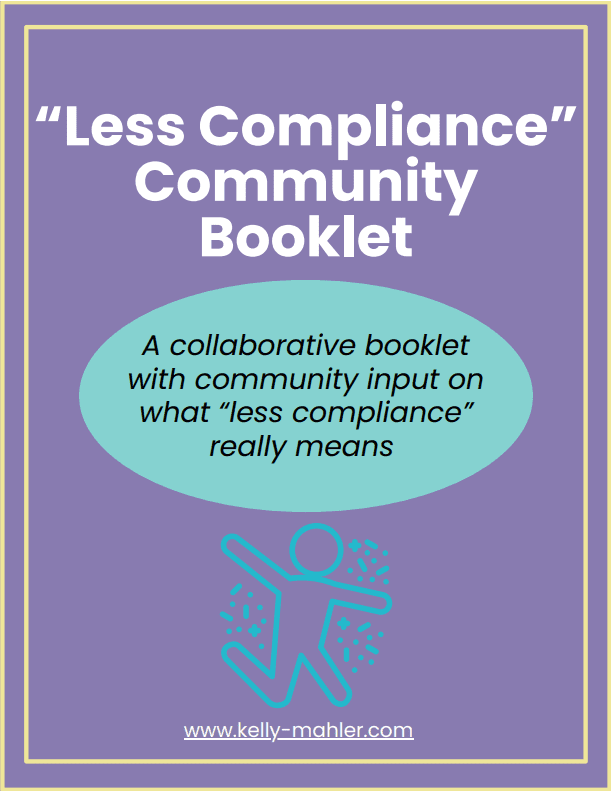
Inside, you’ll find practical, real-world examples shared by educators, therapists, caregivers, and neurodivergent adults who are using a less compliance approach to navigate daily challenges. Their stories are honest, relatable, and full of ideas you can start using right away.
What’s Inside The Less Compliance Community Booklet:
- Real community responses explaining what “less compliance” actually means in everyday practice
- Thoughtful replies to the most common pushback and misconceptions caregivers and educators encounter
- Practical language and framing you can use when others question your approach
- Real-world scenarios from educators, therapists, and caregivers responding with curiosity instead of compliance pressure
- Grounded in the voices of more than 300 community members from around the world
This resource is completely free because every parent and caregiver deserves access to information that can genuinely help.
Ready to Go Deeper? Join The Less Compliance, More Interoception Course
If the booklet resonates with you and you’re ready to understand the why behind all of this and get a clear, practical roadmap, I’d love for you to join me in the Less Compliance, More Interoception on-demand course.
This course is designed for parents, caregivers, educators, and professionals who want to move away from compliance-driven approaches and toward a body-first, interoception-informed way of supporting the people they care for.
This isn’t a course full of abstract theory. Everything is grounded in evidence, rooted in respect for neurodivergent people, and built to be actually usable in real life.
In this course, you’ll learn:
- What interoception is and why it’s the foundation of self-regulation
- How compliance pressure can interfere with interoceptive awareness and what to do differently
- Practical, accessible, less compliance strategies you can use at home and across environments
- How to support body signal recognition in your child in everyday moments
- How to shift from behavior management to genuine self-understanding and co-regulation
Frequently Asked Questions about Less Compliance Parenting
Shifting away from compliance-based approaches can raise a lot of questions, and that’s a good thing. It means you’re thinking critically about what will actually help your child. Here are the ones I get asked most often.
What Is Less Compliance Parenting?
What Is Less Compliance Parenting?
Less compliance parenting is an approach that shifts the focus away from demanding behavioral compliance and toward understanding and supporting a child’s internal body-based experience. It’s rooted in the idea that lasting self-regulation comes from within, and that children need support in noticing and responding to their body signals before they can consistently meet external expectations.
Does Less Compliance Mean I Stop Having Any Expectations for My Child?
Does Less Compliance Mean I Stop Having Any Expectations for My Child?
Not at all. A less compliance approach at home doesn’t remove expectations. It reframes how and when we introduce them. The goal is to recognize when a child’s nervous system is in a state that can actually respond, and to support their body awareness and regulation capacity first. Over time, this builds more genuine, sustainable cooperation than compliance pressure alone.
Is This Approach Only for Autistic Children?
Is This Approach Only for Autistic Children?
No. While a less compliance approach is especially relevant for autistic children and other neurodivergents, it benefits any child who struggles with self-regulation, big emotions, sensory differences, anxiety, or behavioral challenges. The foundation is the same: body awareness first.
How Is This Different from Permissive Parenting?
How Is This Different from Permissive Parenting?
This is a great question, and one of the most common misconceptions. Permissive parenting removes structure. A less compliance approach is about changing the starting point, not eliminating expectations. You are still a caring, responsive, present guide for your child. You’re simply building from the body up, rather than from the behavior down.
Where Do I Start with Less Compliance Strategies at Home?
Where Do I Start with Less Compliance Strategies at Home?
Start with curiosity. Before responding to a behavior, pause and ask what might be happening in your child’s body in that moment. Are they hungry? Overstimulated? Fatigued? Confused? That one question can shift the entire dynamic. For a more structured starting point, download the free Less Compliance Community Booklet above, or join the Less Compliance, More Interoception course for a full framework.
Is the Less Compliance, More Interoception Course Right for Me if I’m a Parent, Not a Therapist?
Is the Less Compliance, More Interoception Course Right for Me if I’m a Parent, Not a Therapist?
Absolutely. The course is designed to be accessible for anyone supporting a child or loved one, regardless of professional background. You don’t need clinical training to benefit. You just need a genuine desire to understand and support the person you care for.
You’re Already Doing Something Right By Asking These Questions
The fact that you’re here, looking for something different, tells me you already sense that there’s more to the story than compliance. And there is.
If you’re not sure where to start, download the free Community Booklet first. It’s a practical, real-world look at what less compliance actually looks like day to day. If you’re ready for a full roadmap, the Less Compliance, More Interoception course walks you through the why and the how in a way you can put to use immediately.
Pick your next step below to start using less compliance at home.