


When someone is non-speaking autistic, their communication may look different from what many people are taught to recognize. This doesn’t mean communication isn’t happening. It means it may be happening through body expressions, movement, and nervous system responses rather than spoken words.
And let’s validate something important for both the non-speaker and the supporter:
When two people use different communication systems, misunderstanding is common. Messages can be missed, dismissed, or misinterpreted, not because anyone is “bad,” but because communication styles don’t automatically match.
Unfortunately, for non-speaking autistic people, this mismatch often results in their communication being labeled as “behavior” instead of being recognized as meaningful interoception expression. This page will show you how an interoception-informed approach helps supporters:
- Observe and think deeply about non-spoken interoception communication
- Respond with curiosity and validation
- Support regulation and felt safety
- Nurture communication growth over time
Language Note: Non-Verbal Autistic vs Non-Speaking Autistic
We recognize that the terms “non-verbal autistic” and “non-verbal” can be deeply aversive to the non-speaking community, as they may imply a lack of thoughts or intelligence, which is far from true. Unfortunately, the continued use of the term “autistic non-verbal” perpetuates harmful stigma.
We use the term non-speaking autistic throughout this page to reflect dignity, presumed competence, and the many valid ways people communicate beyond speech.


What Is Interoception?
Interoception is the body’s internal sense. It helps us notice and interpret signals like:
- Hunger and thirst
- Fullness
- Pain
- Fatigue
- Temperature changes
- Nausea
- A “something feels off” feeling
- Internal stress signals
Interoception helps a person make sense of what their body is experiencing and respond in ways that support regulation, safety, and well-being.
Interoception doesn’t just influence how a person feels inside. It also shapes how and what they communicate. Often, those interoceptive signals show up through the body, through actions, movements, sounds, and nervous system responses.
What Can Interoception Communication Look Like for Non-Speaking Autistic People?
Many supporters assume interoception communication begins only when someone can speak words or use forms of AAC. But for all humans, including non-speaking autistic people (previously “nonverbal autistic”), interoception communication begins much earlier.
The body speaks first, often from minute one of life.
Most infants enter the world wired to notice internal comfort and discomfort and to communicate that experience to the adults around them. Do infants understand their inner world in deep and complex ways? No. Probably not.
But they do communicate their internal state. And importantly, infants vary widely in how that communication shows up. Some infants are loud and obvious about their inner feels. Others are much more subtle. Some may cry, but others might flinch, cuddle in, get tight or loose, turn their head, or zone out.
There are many forms of interoception communication, and it becomes the caregiver’s job to:
- Watch for these expressions of internal state
- Make gentle, curious guesses about what they might mean
- Respond in ways that help the infant’s body feel most comfortable
This same truth is often missed in older children and adults.
As children grow, curiosity often subsides, and many body-based expressions get mislabeled as “challenging behavior,” especially for non-speaking autistic people, when in reality, the body may still be doing what it has always done: communicating comfort, discomfort, and need.
Automatic vs. Reflective Interoception Communication
One of the most helpful ways to understand non-spoken interoception communication is to recognize two forms of early expression:
- Automatic interoception communication (reflexive, body-driven expression)
- Reflective interoception communication (more intentional communication over time)
Understanding these two forms can help supporters respond in ways that protect communication (instead of shutting it down) and create the conditions for more intentional interoception communication to emerge.


Automatic Interoception Communication
Automatic interoception communication includes innate, body-driven expressions of internal comfort or discomfort. These expressions often happen quickly, without planning or intention.
Often, automatic interoception communication shows up as signals of comfort or “this feels good,” including:
- Leaning in for connection
- Snuggling closer
- Relaxing posture
- Softened face or eyes
- Sighing or quieting vocalizations
Automatic interoception communication can also show up as signals of discomfort or “something doesn’t feel okay,” including:
- Crying
- Clinging
- Refusing
- Hiding
- Screaming
- Hitting/biting
These expressions are not choices. They are not manipulation. They are not misbehavior.
They are the body’s first language. And here’s what matters most: When a person learns that their automatic body-based communication will be believed and supported, something powerful happens: They become more willing to take the risk of communicating in ways that require more effort. That shift is what makes reflective interoception communication possible.
Reflective Interoception Communication
Over time, some non-speaking autistic people begin to express inner experience in more intentional ways. This is reflective interoception communication.
This may look like:
- Pulling an adult by the hand
- Gesturing toward a need
- Choosing a sensory item
- Using light tech or high tech AAC
- Typing
- Using spoken mouth words (for some)
Reflective communication often takes significantly more effort. It requires growing interoceptive awareness, reflection, and vulnerability. And it tends to grow when one foundational condition is consistently present:
“When I express how my body feels, I am believed.”
Without that foundation, reflective communication often stalls, not because the person “can’t,” but because why would someone take the risk of communicating more if their earliest communication weren’t honored?
Want Step-by-Step Guidance for Supporting Interoception in Non-Speaking Clients?
These trainings walk you through how to support interoception growth in non-speaking autistic people in practical, neuro-affirming ways.
Early Communicator Course
Not just “good ideas.” This is a practical how-to. Best for toddlers, preschoolers, and early communicators (including non-speaking clients). Learn the exact scripts, strategies, and tools we use, organized into a clear step-by-step process, so you know what to do, what to say, and when to use it.
Interoception & the Non-Speaking Client Course
Best for therapists, educators, and caregivers supporting non-speaking autistic clients. Learn how to adapt interoception supports (including The Interoception Curriculum©) using co-regulation, stabilization, predictability, sameness, and routine, brought to life through real case studies and insights from autistic Social Worker Judy Endow.
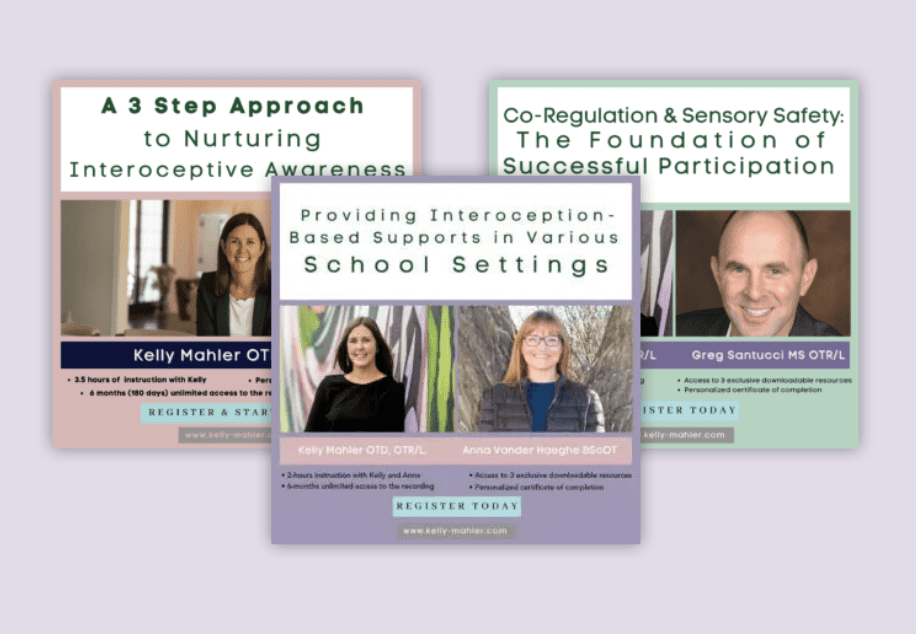
Interoception & AAC Course
Coming later in 2026. Stay tuned for an upcoming course from Caroline Gaddy, autistic SLP & AAC Specialist, focused on the intersection of interoception and AAC. This course is currently in development, with more information coming soon. Keep checking back for updates!
Why Compliance-Based Approaches Miss the Mark
Many traditional approaches to supporting non-speaking autistic people begin with a dangerous assumption: the adult fully knows the “why” or function behind a behavior.
A supporter often sees an interoceptive expression (crying, refusing, bolting, hitting, shutting down) and quickly labels it:
- “Attention seeking”
- “Escape/avoidance”
- “Manipulative”
- “Defiant”
And here’s the shift that often happens next: When an adult’s interpretation becomes the “truth,” compliance has already begun. Because the moment we treat our interpretation as fact, we place adult authority above the person’s actual inner experience. We shut down curiosity.
From there, support often turns into external control, trying to make the expression stop and replacing it with something more “appropriate,” like:
- “Calm down.”
- “Quiet voice.”
- “Safe hands.”
- “Remember what you’re working for (token, sticker, treat)”
- “You can have it when you’re calm.”
- “First work, then reward.”
But many times, adults don’t actually know the why. Interoception is built on a different truth: we don’t know, and we’re willing to be curious together. And let’s be honest. That not-knowing can be vulnerable. But it’s also where real understanding begins.
When we treat body-based expressions as misbehavior, we don’t just reduce “behavior.” We reduce interoception communication. Over time, this can lead to shut down, escalation, masking, and reduced body trust.
Interoception-informed support has the same goal as compliance: less distress and more participation. But the pathway is wayyyyyy different. We don’t try to control the expression. We collaborate to understand what the body is communicating and build the conditions for regulation, safety, and thriving.
3 Interoception-Informed Ways to Support Non-Speaking Autistic People
A person doesn’t need spoken words to support interoception communication. What matters most is how supporters respond to what the body is already expressing, so interoception communication grows (instead of shrinking).
Here are three practical strategies you can start using right away:
Tip 1: Model Your Own Interoception Out Loud
One of the most powerful ways to support interoception growth in ourselves as well as those around us is to model your own inner experience using body-based language.
This shows:
- Body signals matter
- We can use body signals as clues to what our body might need
- It can be tricky to figure out what our body signals mean
Examples (no emotion labeling needed):
- “My body feels tight. I’m going to stretch.”
- “My ears hurt from the noise. I’m putting my headphones on.”
- “Something feels off in my belly. I’m not sure what it needs.”
Try staying with this modeling for a few weeks, without any pressure or expectation for your client or child to respond. This gives us, as adult supporters, a chance to practice noticing interoception in our own daily lives. And if it feels tricky at first, be kind to yourself. This sense can take time to notice and make meaning of. Over time, this practice helps us build a deeper understanding of interoception before we invite someone else further into their own interoception journey.
If you’d like ready-to-use scripts for modeling interoception (without emotion labeling), download the FREE Adult Interoception Modeling Booklet.
Download Noticing Out Loud: An Adult’s Guide To Interoception Modeling
Tip 2: Narrate What You Notice Their Body Doing (Without Interpreting)
When we label someone else’s emotions, we are at high risk of being wrong. Instead, try narrating what you notice their body doing in a non-judgmental way, without attaching a meaning or “why.” This protects dignity and leaves space for the person’s true experience.
Examples:
- “I notice your body is moving away.”
- “I see your hands squeezing tight.”
- “I see you covering your ears.”
- “I notice your body got really still.”
- “I see you reaching for more.”
- “I see you pushing it away.”
This kind of narration communicates, “I’m paying attention to you. I’m not assuming. I’m listening.”
Tip 3: Offer Curious Co-Regulation Scripts (Then Watch for Their Response)
After you narrate what you notice, you can offer co-regulation support using curiosity-based scripts. These scripts don’t require a clear answer. They offer safety, options, and consent, while still keeping communication moving forward.
Examples:
- “Do you want to stop…or keep going?”
- “Show me what you need.”
- “Do you want more…or all done?”
- “Let’s try a different way?”
Then watch the body:
- Do they move toward or away?
- Do they settle or escalate?
- Do they reach, push, freeze, relax, or disconnect?
The body often answers before words ever arrive. If it seems that you guessed their need right, great! If not, apologize and stay with them. Keep offering curiosity and presence.
Can The Interoception Curriculum© Be Used With Non-Speaking Autistic People?
Yes! The Interoception Curriculum© is used frequently and very successfully with lots of non-speaking autistic children and adults. It does not require mouth words (spoken language).
One of the most powerful strategies for non-speaking clients is Focus Area Experiments. These concrete, sensory-based experiments allow the person to explore sensations. At the same time, supporters observe and respond with curiosity, without assumptions or labeling.
This might sound like:
- “More… or all done?”
- “Keep going… or stop?”
- “Try again… or no more?”
Over time, these experiments can help everyone notice patterns: what feels comfortable vs. uncomfortable. The Descriptor Menus from The Interoception Curriculum© can also support communication through language, like:
- “My body feels comfortable.”
- “My body feels uncomfortable.”
“My body feels comfortable.”
Frequently Asked Questions About Interoception and Non-Speaking (Previously “Non-Verbal”) Autistic People
Supporting non-speaking autistic people with interoception often comes with questions. Here is a list of some of the most frequent ones we hear.
How Can I Support a Non-Speaking Autistic Child (Previous Term: Non-Verbal Autistic Child) Without Mislabeling Emotions?
How Can I Support a Non-Speaking Autistic Child (Previous Term: Non-Verbal Autistic Child) Without Mislabeling Emotions?
This is such an important question because emotion labeling is high-risk. It requires interpretation, and we are often wrong. Instead of labeling emotions (e.g., “you’re mad” or “you’re anxious”), try:
- Narrating what you notice their body doing (“I notice your body moved away.”)
- Offering curiosity scripts and watching for a non-spoken response (“Do you want to stop or keep going?”)
- Supporting regulation through co-regulation (“Let’s figure out what your body needs.” “Do you want space or closeness?”)
This helps protect body trust and supports interoception communication, because the child learns:
“When my body communicates, someone will be curious and try to understand me. I will be believed.”
What Does Presuming Competence Mean for Non-Speaking Autistic Clients (Previous Term: Autistic Non-Verbal), and Why Does It Matter for Interoception?
What Does Presuming Competence Mean for Non-Speaking Autistic Clients (Previous Term: Autistic Non-Verbal), and Why Does It Matter for Interoception?
Presuming competence means we assume the person has meaningful thoughts, preferences, intelligence, and understanding, even if they don’t use spoken language.
This is especially essential in interoception work because interoception is deeply internal. We cannot directly see another person’s sensations, discomfort, pain, overwhelm, or needs. So, if we don’t presume competence, we’re more likely to:
- Override body-based communication
- Treat distress as “behavior”
- Assume the person is not aware, not communicating, or not reliable
Presuming competence helps us stay in the correct posture for interoception support: curiosity, humility, and respect. In practice, presuming competence for interoception looks like:
- Believing body-based expressions are real communication of internal comfort or discomfort
- Offering autonomy and choices (instead of compliance)
- Providing robust access to AAC supports
- Speaking with dignity (talking to them, not talking about them)
- Adjusting our approach when something doesn’t work, rather than blaming the person
This is how interoception becomes what it’s meant to be: a process of inner self-discovery, supported, not controlled.
Why Does My Non-Speaking Autistic Child (Previous Term: Non-Verbal Autistic Child) Have Meltdowns or “Challenging Behavior”?
Why Does My Non-Speaking Autistic Child (Previous Term: Non-Verbal Autistic Child) Have Meltdowns or “Challenging Behavior”?
Many non-speaking autistic children communicate discomfort through their bodies because they do not yet have a reliable way to express what’s happening inside through spoken language (mouth words) or AAC.
So, what often gets labeled as “challenging behavior” may actually be the body communicating:
- Overload
- Discomfort
- Fear
- Pain
- Confusion
- Unmet sensory needs
- A need for safety or co-regulation
Meltdowns, shutdowns, bolting, refusing, freezing, or aggression are not “defiance.” Many times, they are signs that the nervous system is overwhelmed and the body is doing the best it can to communicate.
An interoception-informed approach shifts the goal from controlling behavior to understanding the body: “What might their body be telling us?” instead of “How do we stop this behavior?” Same end goal, but a different way to get there.

Final Thought: Interoception Communication Grows When People Feel Believed
Automatic interoception communication is the root.
Reflective interoception communication is the bloom.
When non-speaking autistic people are consistently believed in their body-based communication, they are far more likely to risk communicating more over time, through gesture, AAC, or spoken language (when/if available).
Interoception support is not about control. It’s about validation, belief, curiosity, and admitting we’re not sure, and staying committed to figuring it out together.
Want a clear, neurodiversity-affirming way to begin supporting interoception (without relying on spoken language)? Start with The Interoception Curriculum©.