


This article explains how interoception supports early communication in preschoolers and non-speaking children by reframing behaviors as meaningful body-based communication. It shows how responding with curiosity and validation supports regulation and builds readiness for gestures, AAC, and spoken language.

When children don’t yet have the words to explain how they feel, adults are often left guessing and many times their innate expressions of inner experiences are easily misread as “challenging behavior.”
Crying, clinging, refusing, screaming, freezing, or shutting down are frequently treated as problems to correct instead of interoception communication to understand. This is especially true for preschoolers and non-speaking children, whose bodies are doing the talking long before spoken language or Augmentative and Alternative Communication (AAC) is available.
An interoception-informed approach offers a different starting point. One that helps adults be curious and unpack what’s happening inside the child’s body and respond in ways that validate and support communication development.
What Is Interoception and Why Does It Matter for Early Communication?
Interoception, our sense that allows us to notice and interpret internal body signals, such as hunger, fullness, discomfort, pain, temperature, anxiety or joy, is foundational for early communication.
Before a child can say “I’m hungry,” point to a symbol, or use a device, many times their body is already expressing those inner experiences. Many times, this is interpreted as a behavior that needs to be corrected. Crying, running away, clinging; these are all examples of ways that a child’s body is expressing a need before they are able to directly tell an adult what they’re experiencing.
Understanding interoception can help adults recognize that communication doesn’t begin with words, it begins inside the body through two forms of Interoception Communication.
Automatic Interoception Communication: How Communication Starts
The earliest form of communication is Automatic Interoception Communication. These are innate, reflexive expressions of how the body feels. They happen automatically, without planning or intention.
Examples include:
- crying
- clinging
- refusing
- hiding
- screaming
- freezing
- covering ears
- snuggling
- leaning in for a kiss
These expressions are not choices.
They are not manipulation.
They are not misbehavior.
They are the body’s first language.
Reflective Interoception Communication: A Risk Children Take
Over time, some children begin to express how their body feels in more purposeful, intentional ways. This is called Reflective Interoception Communication.
This may look like:
- pulling an adult by the hand
- choosing a sensory item
- pointing to a picture or card
- using spoken words
- using AAC or a communication device
Reflective communication often takes significantly more effort.
It requires awareness, reflection, and vulnerability.
Children take this risk when they’ve learned one critical thing first:
“When I express how my body feels, I am believed.”
Without that foundation from the adults around them, reflective communication often stalls in early communicators.
Why Compliance-Based Approaches Miss the Mark
Many traditional behavior approaches insist on identifying the “function” of a behavior as quickly as possible.
It’s attention-seeking.
It’s avoidance or escape.
But expressions of inner experience rarely fit into one tidy box.
When adults prioritize certainty over curiosity, and push to label an expression as a problematic behavior; children learn that their automatic expressions are unwanted. Why would they invest more effort to communicate if their earliest attempts weren’t believed or taken seriously?
Interoception-informed support shifts the goal from changing behavior to understanding experience.
3 Tips to Support Interoception in Early Communicators
Tip 1: Respond to Automatic Expressions With Curiosity, Not Control
Automatic Interoception Communication deserves belief, not correction.
Instead of trying to stop the expression, stay with it, wonder about what it could be telling you about their internal state.
This might sound like:
- “I see you crying. Let’s figure out what you need.”
- “I see you leaning on me. Do you need a squeeze?”
- “I’m not sure what you need right now. Show me.”
- “I’m really trying to figure out what you need right now. Can you help me?”
You don’t need to know the “why” to offer these statements of validation.
They don’t need to be able to respond to these statements in order to receive the genuine curiosity and care from you.
Believing the person comes first. Understanding what they need usually follows.
By creating felt safety for the child we are showing them that we accept their needs and it’s okay to express them. This builds trust and encourages them to continue communicating their needs in whatever way they can.
Learn more about interoception-based supports here.

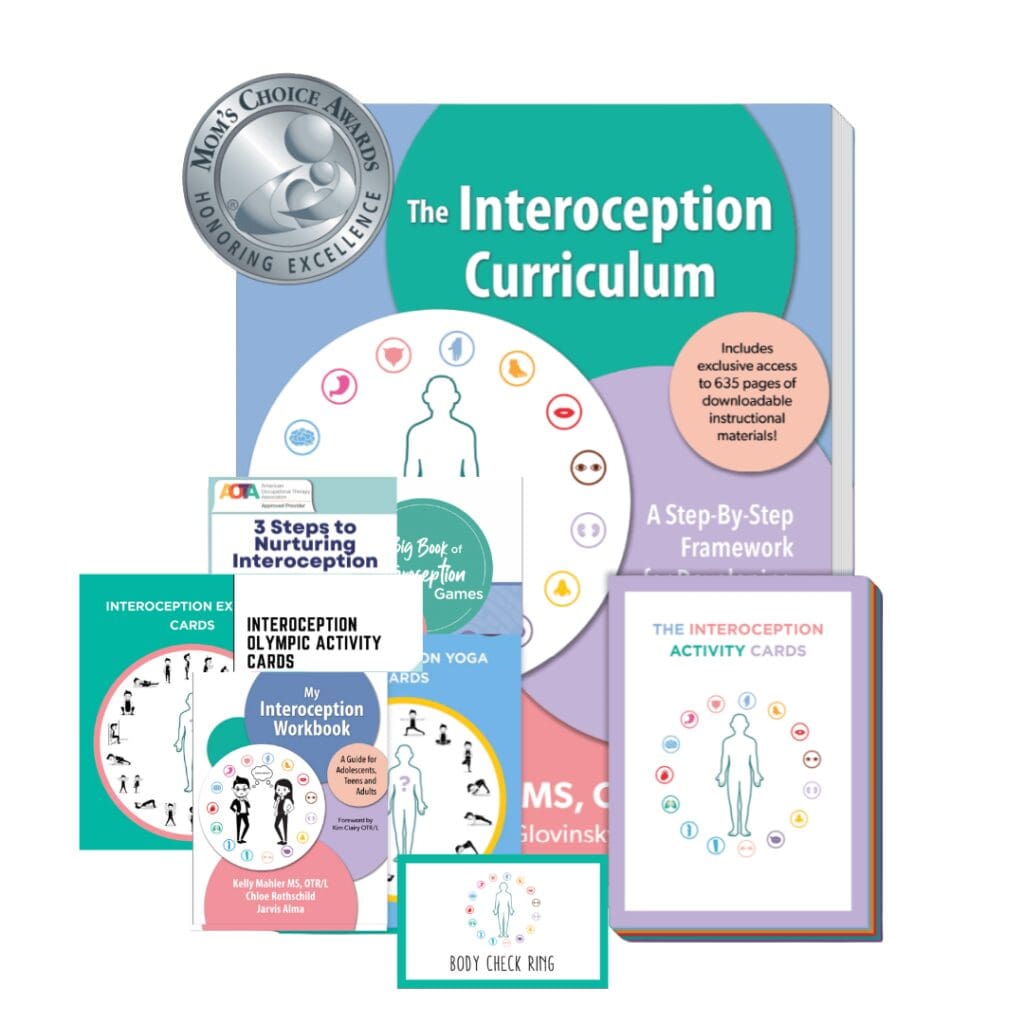
Tip 2: Use The Interoception Curriculum to Create Opportunities for Exploration and Validation
The Interoception Curriculum (IC) offers a structured, playful way to explore what a child’s body might be communicating, without pressure to perform or explain.
One of the most widely used strategies from the curriculum, Focus Area Experiments, creates intentional opportunities for children to:
- notice body sensations
- express internal experiences
- experience autonomy, curiosity, and validation
A Focus Area Experiment might be as simple as offering an ice pack or a light-up toy and observing how the child responds.
A child might:
- refuse to try the experiment
- briefly touch it and immediately pull their hand away
- engage deeply and want to continue the experience
Each response gives us a chance to acknowledge what we observe and show that we believe them.
For example, if a child touches the ice pack and quickly recoils, an adult might say:
“Oh, I saw you touch the ice and then pull your hand away. Maybe your body didn’t like that. Let’s put it away.”
Or if a child continues playing with a light-up toy when it’s time to move on, an adult might respond with curiosity:
“I see you’re still holding the toy. I wonder if your body wants to keep looking at that for a little longer.”
In these moments, we’re not testing, pushing, or interpreting for the child, we’re learning alongside them. Focus Area Experiments allow children to explore sensations on their own terms while adults practice noticing, validating, and staying curious.
Over time, this repeated experience of being believed helps build interoceptive awareness and trust, laying the groundwork for more intentional, reflective communication to grow.
Tip 3: Model Your Own Interoceptive Awareness Out Loud
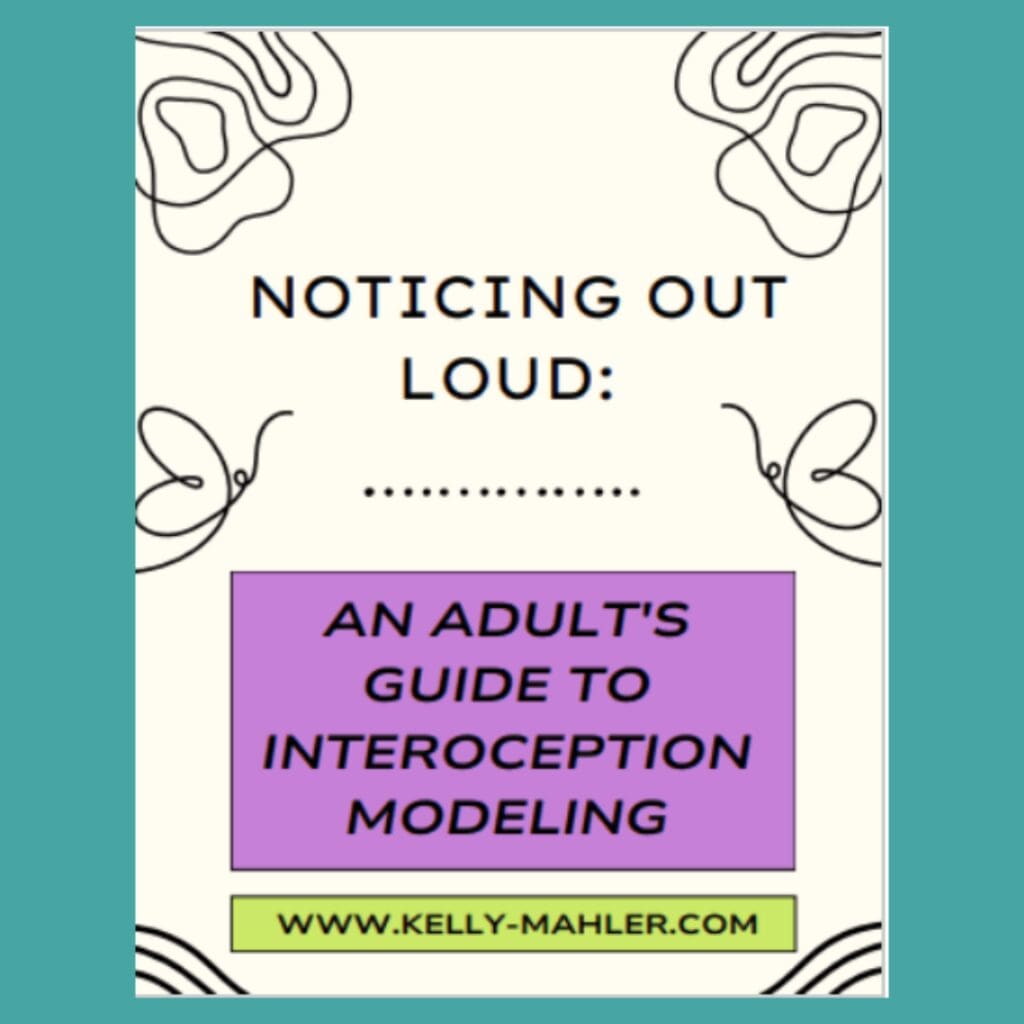
Children can learn how interoception communication works by listening to adults make sense of their own bodies.
Modeling might sound like:
- “My shoulders feel tight. I think I need a stretch.”
- “My ears hurt from the noise. I’m going to put on my headphones.”
- “I’m moving closer because my body needs a squeeze.”
- “I’m having a strange feeling in my belly. I wonder if I’m hungry or maybe something else.”
This shows children that:
- everyone has internal experiences
- noticing the body can be helpful
- interoception communication can be curious without needing all the answers
Modeling builds a bridge between automatic and reflective communication. Without pressure.
Click here to get a copy of our free resource on interoception modeling.
Communication Grows When Children Feel Believed
When children feel believed in their earliest expressions, they are far more likely to risk sharing more over time, especially through ways that require more effort–gestures, symbols, devices, words, etc.
Automatic Interoception Communication is the roots.
Reflective Interoception Communication is the bloom.
Interoception & Early Communication: Supporting Preschoolers, Non-Speaking Children & Beyond
When children don’t yet have the words to explain what they’re feeling, adults are often left guessing and interoception expressions are easily misread as “challenging behavior.” Our Early Communication course offers an interoception-informed framework with practical scripts, visuals, and communication tools that support curious, respectful guesswork while keeping the child actively involved in meaning-making. You’ll learn how to respond to automatic interoception expressions (like crying, clinging, or refusing) and how to support a natural progression toward more reflective communication (such as choosing sensory supports or expressing pain with a device). All registrants will receive access to a light tech Interoception Communication Board and the all new Interoception Response Cards.
Frequently Asked Questions About Early Communication, Behavior & Interoception
Why does my child act out but can’t explain what’s wrong?
When children don’t yet have the words to explain what’s happening inside their body, their discomfort often shows up through ‘behaviors’ such as crying, clinging, refusing, or meltdowns. These expressions are forms of Automatic Interoception Communication—the body’s way of saying something doesn’t feel right before language is available.
How can I help a non-speaking child communicate their emotions or needs?
Non-speaking children often communicate through their bodies long before they can use mouth words or alternative forms of communication. Responding to these expressions with curiosity and validation, helps children feel believed in their innate communication attempts and supports the desire to put more effort into communication growth.
How can an interoception approach help non-speaking children communicate?
An interoception approach helps children notice and make sense of internal body signals indicating things like hunger, discomfort, or overwhelm through lots of curiosity about what inner feels the child is experiencing. When adults honor a child’s Automatic Interoception Communication, such as crying, clinging, meltdowns, children are more likely to take the risk and effort to develop Reflective Interoception Communication, such as gestures, symbols, AAC, or words.
Why doesn’t correcting behavior help children communicate better?
Correcting behavior without understanding the internal experience driving it can make children feel misunderstood or dismissed. When automatic expressions are ignored or punished, children are less likely to risk sharing more intentional forms of communication later.